Niehoff horse transporter for everyone: thanks to the lightweight chassis from AL-KO VT
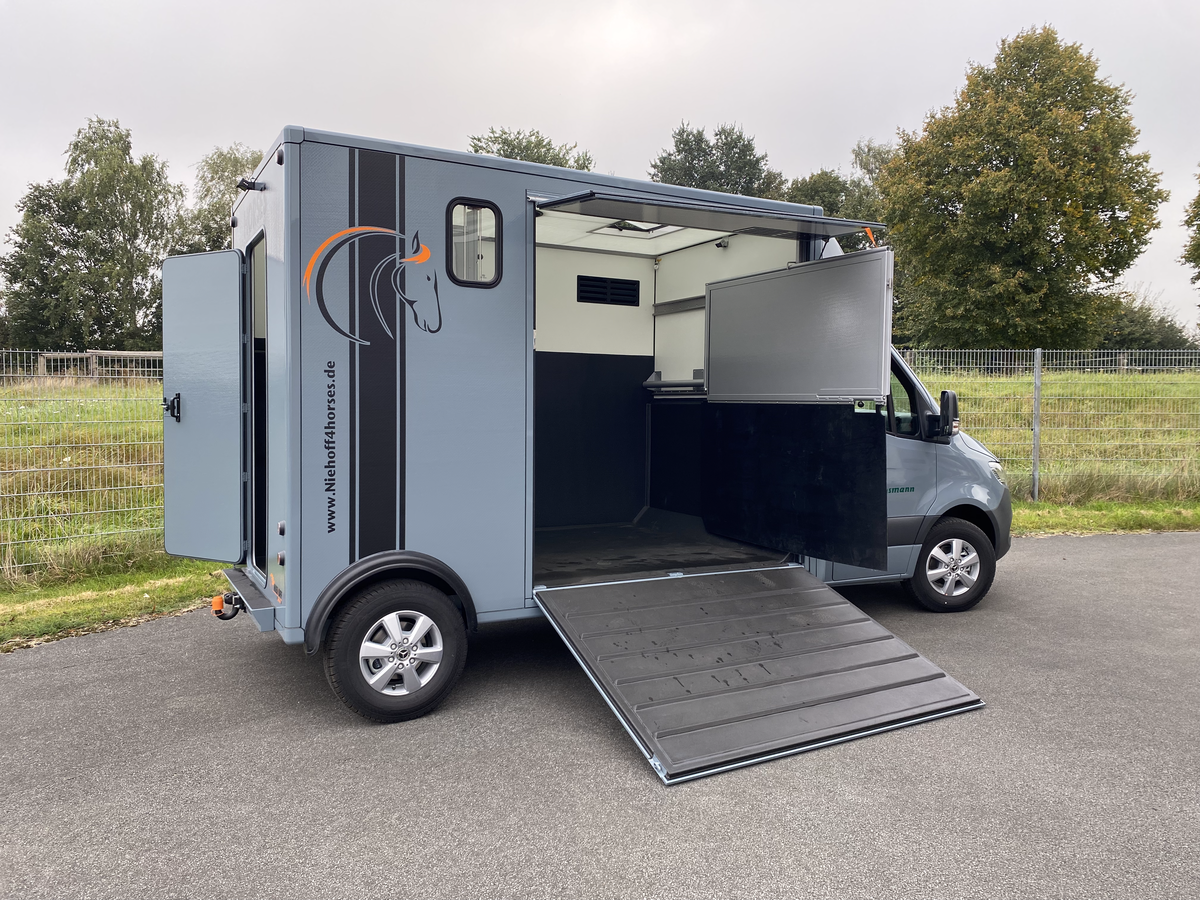
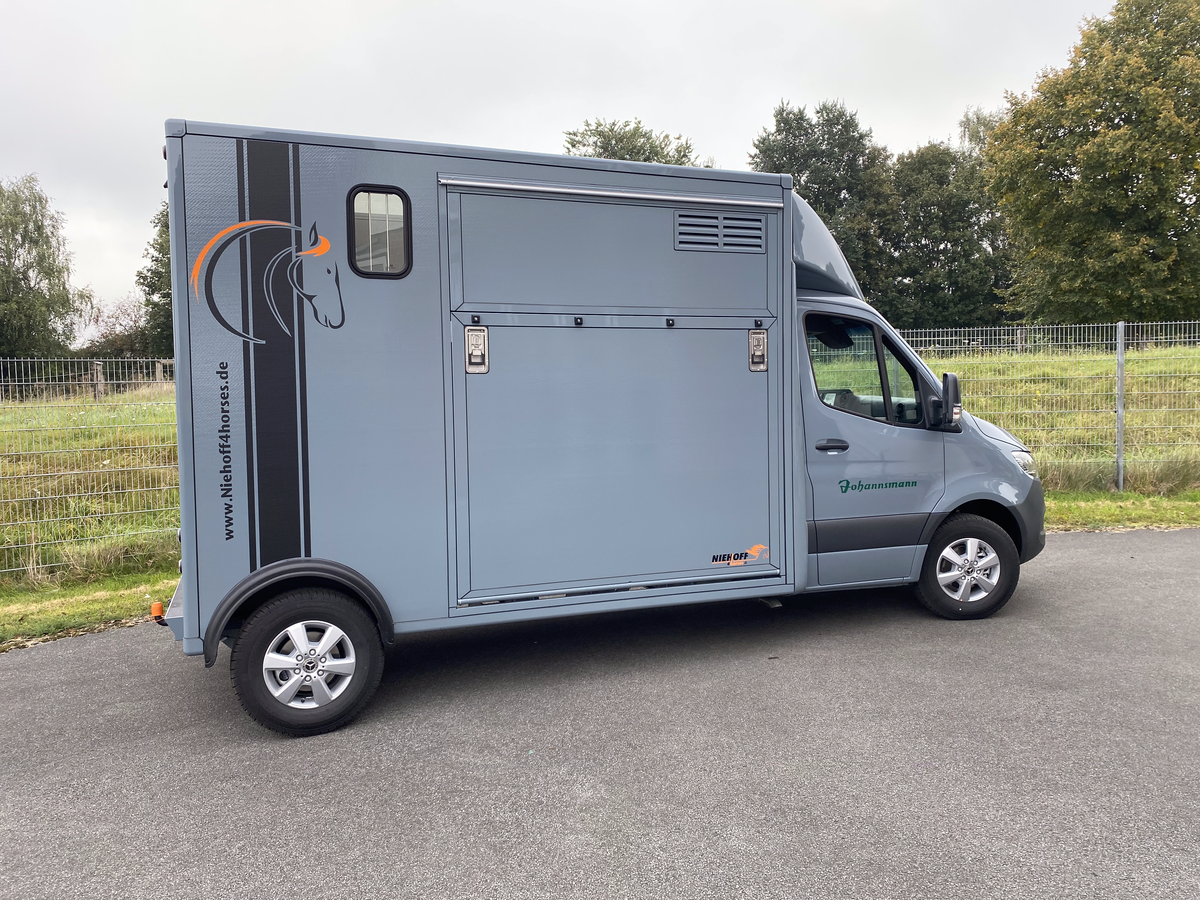
Transporting horses presents challenges in terms of safety and ride comfort for the four-legged passengers. There is also the fact that the high weight of these vehicles, as well as handling trailer combinations, generally requires an upgraded driving licence. The vehicle builder Niehoff has found a solution for all of these issues: a horse transporter that is particularly lightweight.

Facts about the collaboration between Niehoff and AL-KO VT
- The vehicle builder Niehoff designs custom-made horse transporters and relies on chassis from AL-KO VT.
- The AMC low-frame chassis is 220 mm lower than standard versions, making transport more comfortable and safer for both horse and rider.
- Thanks to the lightweight construction, among other factors, the vehicle's permissible gross weight is under 3.5 tonnes and does not require an additional driving licence.
AL-KO VT on tour with horse and rider
Horse transport made easy
They say happiness on earth is found on the back of a horse. This is also true for bodywork and vehicle manufacturer Heinrich Niehoff, who is dedicated to developing horse transporters that are as light as possible: At the medium-sized vehicle manufacturer based in North Rhine-Westphalia, the well-being of the horses is always the top priority. According to Niehoff’s philosophy, horses can only perform at their best if transport is safe and stress-free. For body construction, the family business had a very specific partner in mind – AL-KO Vehicle Technology.
What began in 1895 as a small workshop for carriages and horse-drawn wagons in the Münsterland region is today one of the most renowned bodywork businesses for transporters and trailers – Niehoff Karosserie- und Fahrzeugbau GmbH & Co. KG in Füchtorf, Germany. Well over 500 custom-built horse transporters have left the Niehoff production halls over the past decades – for professional riders as well as for leisure riders or freight companies.
AL-KO VT lightweight chassis for minimal weight
Every kilogramme counts
The design and construction of these special vehicles is no trivial matter: they must retain their value, be durable, easy to maintain and robust, whilst also meeting the individual requirements and expectations of the customers. The most important aspect is weight. For the vehicle to be used with a Class B driving licence and to avoid high motorway tolls – for example in Austria or France – every kilogramme counts.
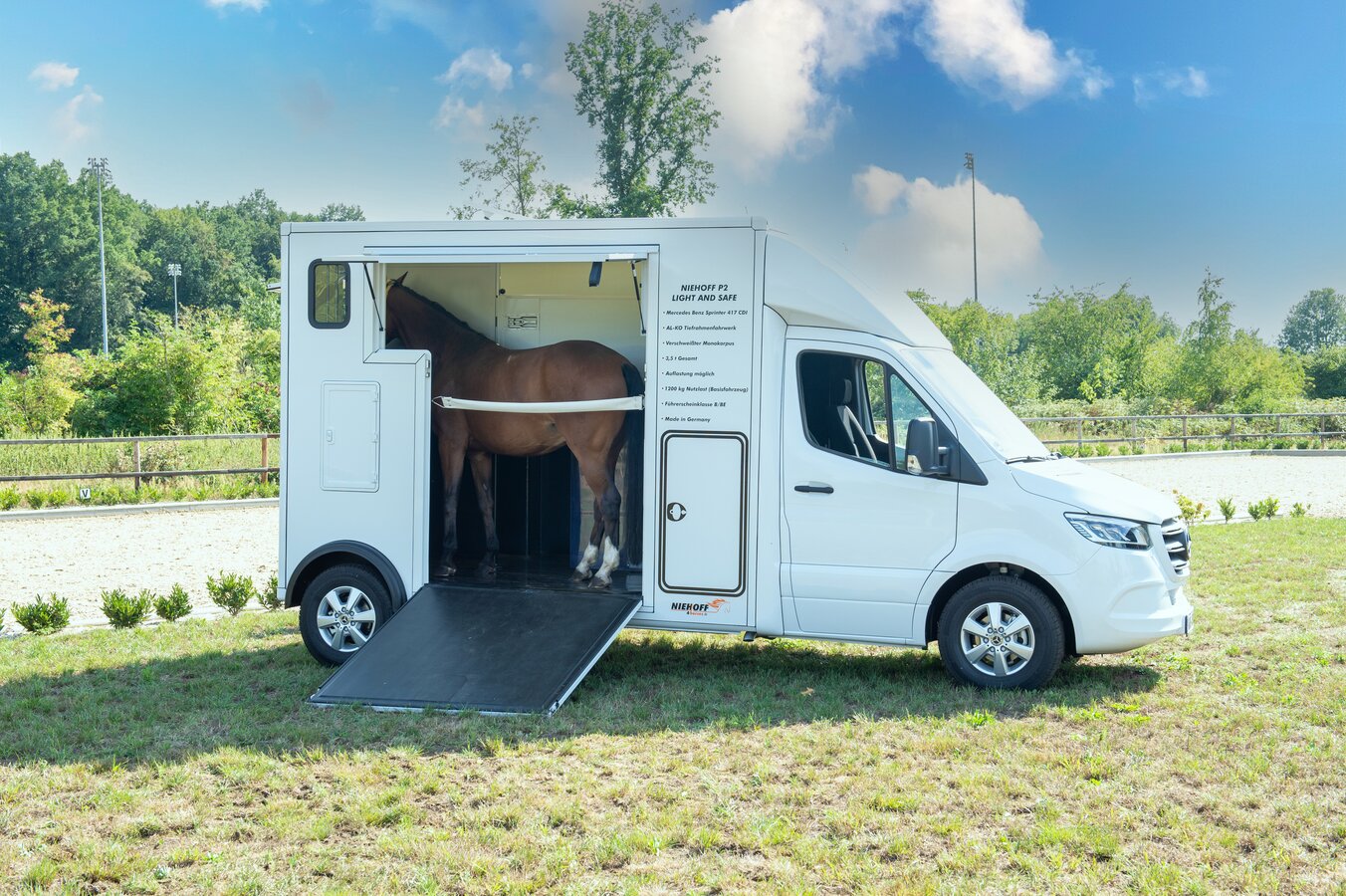
“The aim was to build a three-and-a-half tonne vehicle to be able to transport two horses,” explains Managing Director Heinrich Niehoff, detailing the technical challenge. The issue: all standard chassis available in the 3.5-tonne class were simply too heavy in terms of their own weight. In addition, a Mercedes-Benz drive head was to be used, and the payload maximised as far as possible. Niehoff: “Our plan was to have 1,200 kg available.” According to the Managing Director, there could only be one partner for such a plan: “AL-KO is known for its chassis being very flexible when it comes to dimensions, weight and axle width. That made the company the right choice for our needs.”
AL-KO VT lightweight chassis for flexible concepts
The optimum maximum weight is 3.5 tonnes
According to Niehoff, the Mercedes-Benz drive head was previously intended only for motorhomes. “We received confirmation from Mercedes-Benz that the drive head could also be used for horse transporters.” This cleared the way to use the proven AL-KO VT chassis to design a horse transporter with a maximum gross weight of 3.5 tonnes.
“There was simply no alternative.” All other available low frames from other manufacturers were not only too heavy, but also much less flexible than the AL-KO VT chassis. Niehoff goes into detail: “The combination with AL-KO has proved to be the best, also in terms of driving safety and configuration.” The new transporter features a very wide rear axle, ensuring it remains stable against swaying even when fully loaded. According to Niehoff, other important requirements were the lowest possible entry height for the horses, a low centre of gravity, and wide tracks.
“The payload was absolutely crucial. There’s no point developing a vehicle with a payload of 600 kg if you're intending to transport two horses,” says the Managing Director. A horse weighs on average 400 to 700 kg, depending on the breed. Some heavy breeds can easily weigh over 1,000 kg, meaning the transporter can still be used to carry a single animal.
“Special ideas need special solutions. With our modular systems and chassis variants, such as the lightweight chassis, we aim to provide just such solutions,” says Philipp Nief, Key Account Manager Sales Light Commercial Vehicle at AL-KO VT. “For our customer Niehoff and his horse transporter, it paid off completely. We were able to give him exactly what he needed to turn his idea into reality – and all at the usual high quality and stability. Every success for our customers is also a success for our company.”
AL-KO VT: Your partner for every case
Safe and comfortable horse transport
Today, Niehoff has a transporter with a “proper chassis for a proper towing vehicle” – for horses and for people. The Class B driving licence played a special role in the partnership with AL-KO VT, ensuring that the transporters with a maximum permissible weight of 3.5 tonnes can be driven without the need for an upgraded licence. “Of course, this also affects insurance matters and additional equipment such as saddles, horse feed and accessories.” The vehicle now features a storage compartment 60 cm wide, which can house a sleeping area for long journeys and competitions or a tack room.
The horses themselves also have plenty of space: “There should be 1.60 metres between the wheel arches—this is the standard width for a regular two-horse trailer.” According to Niehoff, the horses stand with their weight centred over the rear axle, relieving the load on the front axle. Many other horse transporters are overloaded at the front. However, the Niehoff vehicle can transport a horse trailer carrying two additional animals alongside the two horses in the transporter itself. “We are now planning for a volume of 10 to 20 vehicles per year – provided the manufacturers can deliver.”

After subscribing, you will receive exclusive information on products, news, offers and more straight to your email inbox.