Stable parking in any situation with the right caravan supports
For campers, properly supporting the caravan is key to a successful holiday. This ensures that the caravan doesn’t wobble at every slight movement and remains properly levelled.
We’ll show you the differences between AL-KO VT’s support systems and answer the frequently asked question of whether supports can be used for levelling or jacking up – for example during long winter storage periods.

Supports for the caravan: the essentials at a glance
- Even simple manual steady legs enable a safe and stable stand. For even greater comfort, there are electric and hydraulic supports.
- Hydraulic levelling support systems automatically level your caravan at the touch of a button.
- Relieving the load via the steady legs is fully sufficient for winter storage.
Hydraulic caravan supports
The Rolls-Royce of support systems
If you’re travelling with a caravan and finally find the ideal spot for the night, there’s only one thing you want: set up the caravan and relax. But often the ground is uneven and rarely is a pitch so flat that you can align the caravan in a matter of moments. Usually, setting up takes up valuable holiday time spent with a spirit level and placing wheel chocks.
But help is at hand: With hydraulic levelling support systems, the stress of setting up and aligning the caravan is a thing of the past. Unlike mechanical and electromechanical systems, hydraulic levelling support systems fully automatically level your caravan at the touch of a button. In just a few minutes, your caravan stands perfectly, both longitudinally and laterally, and your holiday can begin.
LevelC hydraulic levelling support system from AL-KO VT
The hydraulic LevelC levelling support system from AL-KO VT takes just a few minutes to bring a caravan into a precisely level position fully automatically.
A total of six hydraulic supports do all the hard work. In the first step, two main supports fitted to the left and right of the axle extend and bring the vehicle to level across the width. In the second step, the longitudinal axis is aligned. Instead of mechanical corner steadies, the LevelC system uses hydraulic Big Foot corner steadies to ensure the caravan ends up perfectly level. An electronic spirit level housed in the control unit makes the job even easier.
The system can be controlled either via a permanently installed control panel or a small touch pad, which is placed in a stationary charging station in the caravan, but can be removed at any time. In this case, the tablet functions as a wireless remote control, allowing the entire system to be operated from outside.
It's probably impossible to set up a caravan more quickly and automatically. The transverse alignment first, then the longitudinal alignment, and the parallel movement of the pairs of supports also protect the chassis from damaging torsional forces.
LevelC is available as a complete system with six hydraulic supports, or alternatively as a compact system with two hydraulic axle supports and four mechanical corner steadies. One real added benefit: LevelC is compatible with almost every type of caravan up to a permissible gross weight of 3.5 t and can be dismantled at any time and installed in another caravan.
- Suitable for: LevelC is compatible with almost all caravan types up to 3.5 t permissible gross weight and can be removed at any time and reinstalled in the next caravan.
- Price: €3,500 plus installation (Note: LevelC may only be retrofitted at certified specialist workshops or an AL-KO VT customer centre)
- Weight: The extra weight compared to standard equipment is approx. 20 kg (the existing corner steadies are replaced).
Electrically operated supports
For extra convenience when parking
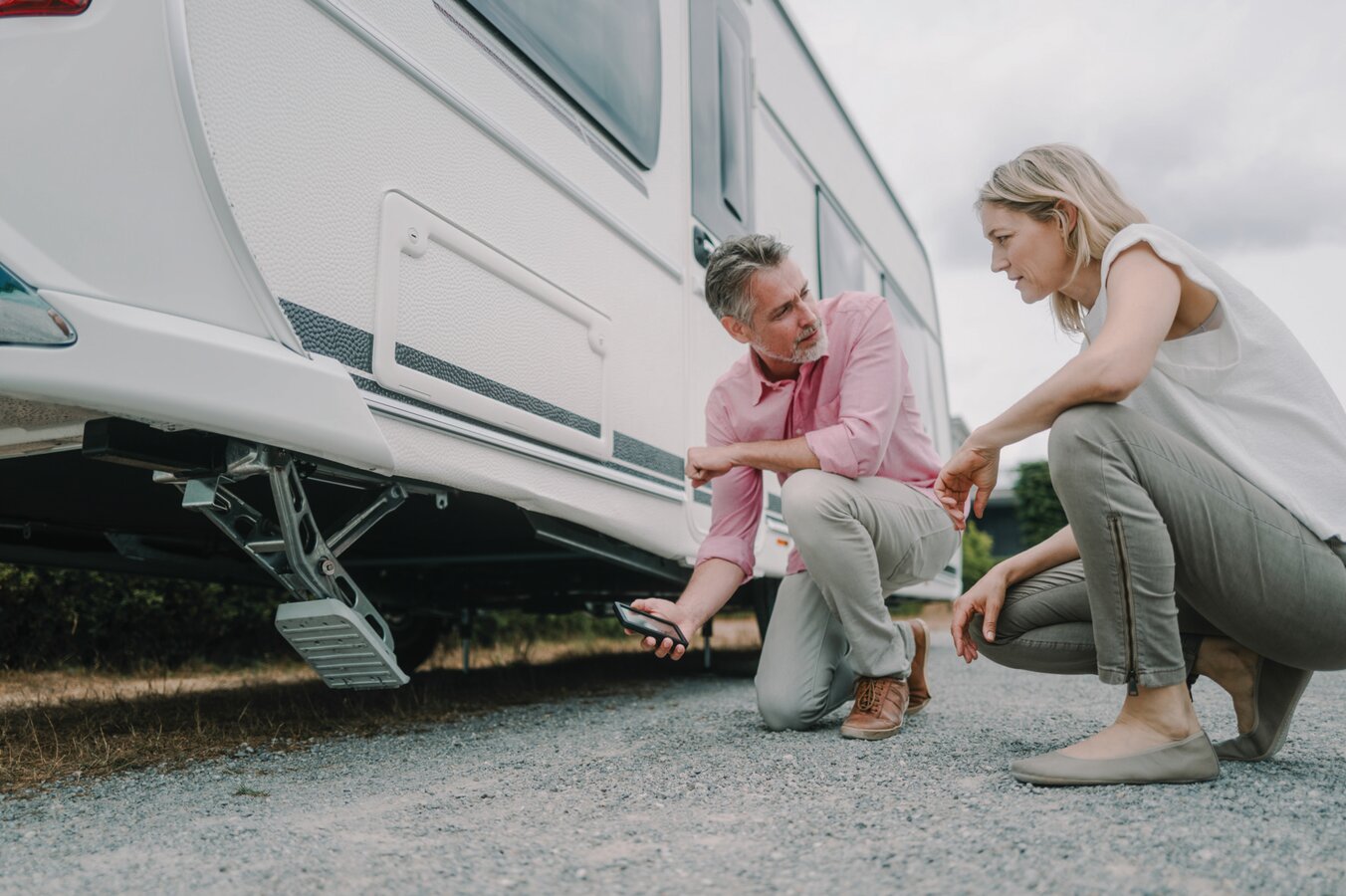
If you’re tired of winding and don’t fancy any more squats, support systems with electric motors offer a convenient alternative. Electric supports are the right choice for anyone wanting to protect their back and park their caravan without stress. This is especially appreciated by tourers who regularly change their pitch and enjoy the added convenience.
Tip: On small sites, electric supports have another advantage: You can park your caravan close to hedges or boundaries as there’s no need to leave space for manually winding the supports down.
UP4 electromechanical support system from AL-KO VT
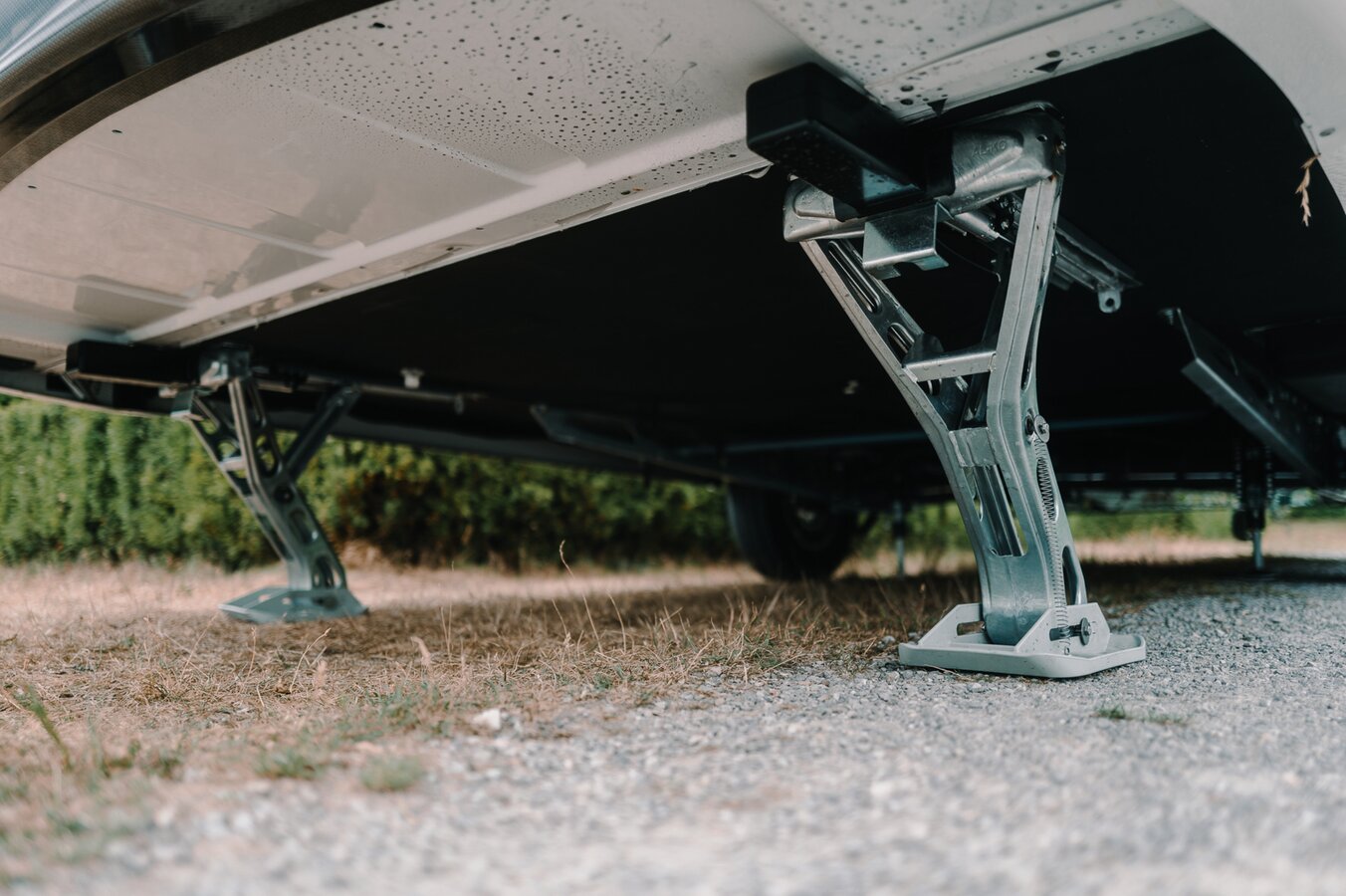
With the UP4 electromechanical support system from AL-KO, setting up is more comfortable and quicker than with a hand crank. Using a remote control, all four supports can be extended electrically and then individually positioned to the correct level. This saves time and allows you to park your caravan stably at the touch of a button and without any effort.
UP4 is compatible with caravans up to 2.5 tonnes and thanks to its hot-dip galvanised metal parts, it is protected against corrosion so you can enjoy your supports for many years. The premium version comes with AL-KO VT Big Foot support feet as standard, providing the necessary stability on soft ground.
Another advantage: The UP4 can be perfectly combined with the AL-KO VT manoeuvring system Ranger. Together, they form a real dream team. While the AL-KO VT Ranger positions your caravan securely even on steep or tight pitches, the UP4 can then do its job straight away. Both functions are operated with a single remote control for maximum user convenience.
Thieves stand no chance with the UP4 support system. A built-in anti-theft device ensures the supports can only be moved manually using a special key. Unauthorised access is impossible.
- Suitable for: UP4 supports fit almost all caravan chassis and can also be retrofitted.
- Price: €1,400 plus installation
- Weight: The additional weight of UP4 is only 17.5 kg compared with the standard equipment, as here too the four existing corner steadies are replaced.
Mechanical supports
The classic among caravan supports
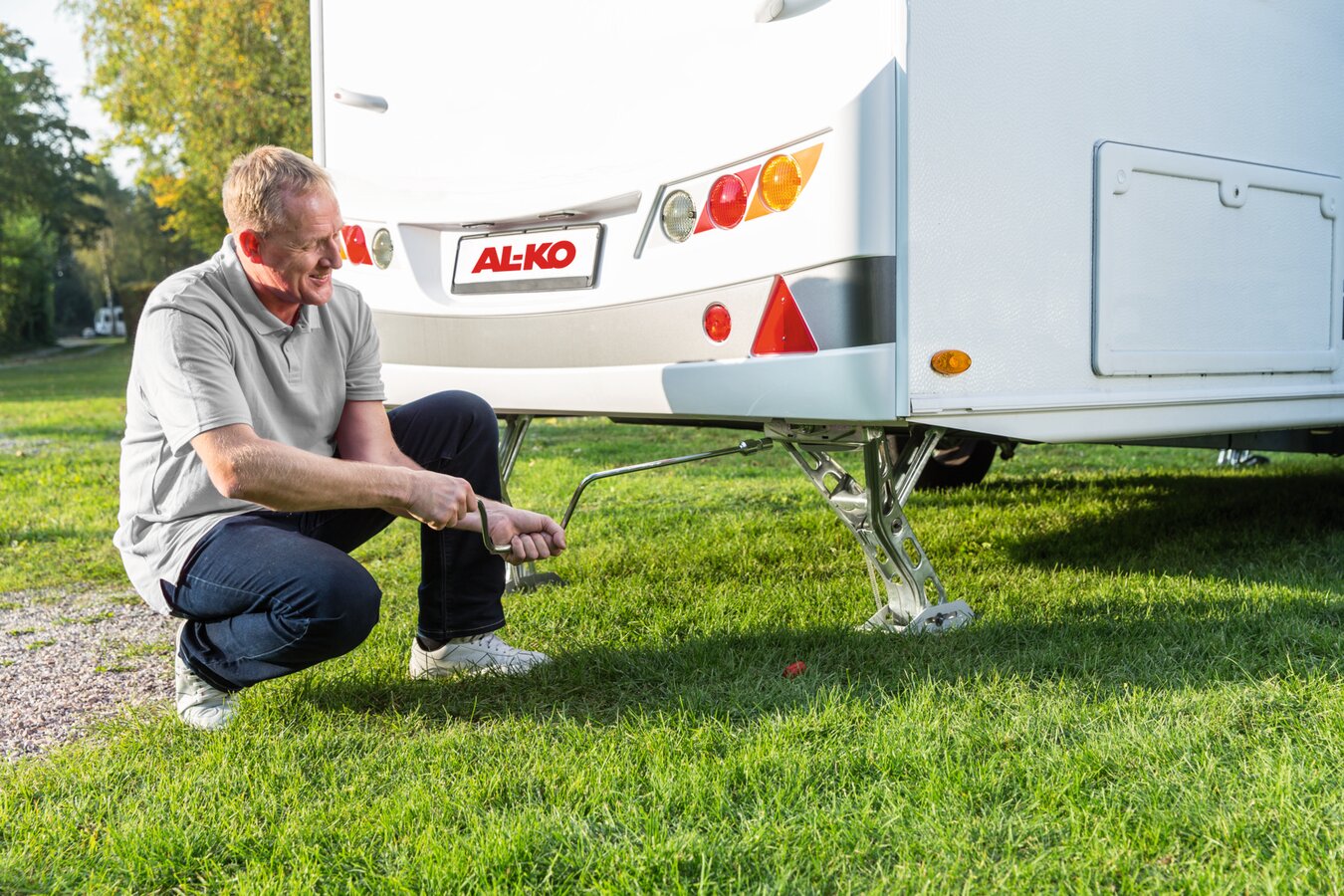
Ideal for all campers who prefer to manually support their vehicle by winding, mechanical supports provide a stable stand on any terrain. They are easy to install and are available in various versions for every chassis. If you park your caravan on soft ground such as sand, mud, or snow, even the best support can easily sink in. In such cases, it is advisable to use a stable surface (e.g. wooden boards, stone slabs or AL-KO VT Big Foot support feet).
Available in the webshop!
Mechanical supports are robust and easy to use. However, a common practice should be avoided: raising and lowering the supports with a cordless screwdriver. While this may seem more convenient than hand operation, in particular powerful tools can unintentionally lift the caravan. This can result in damage to the bodywork, the thread or the screw mount. If you still wish to use a cordless screwdriver, take great care that the tool does not run at full power.
AL-KO VT plug-in supports
The plug-in supports from AL-KO VT are available in two versions: the Stabilform supports can carry up to 1,000 kg permissible gross weight, premium supports even up to 2,500 kg.
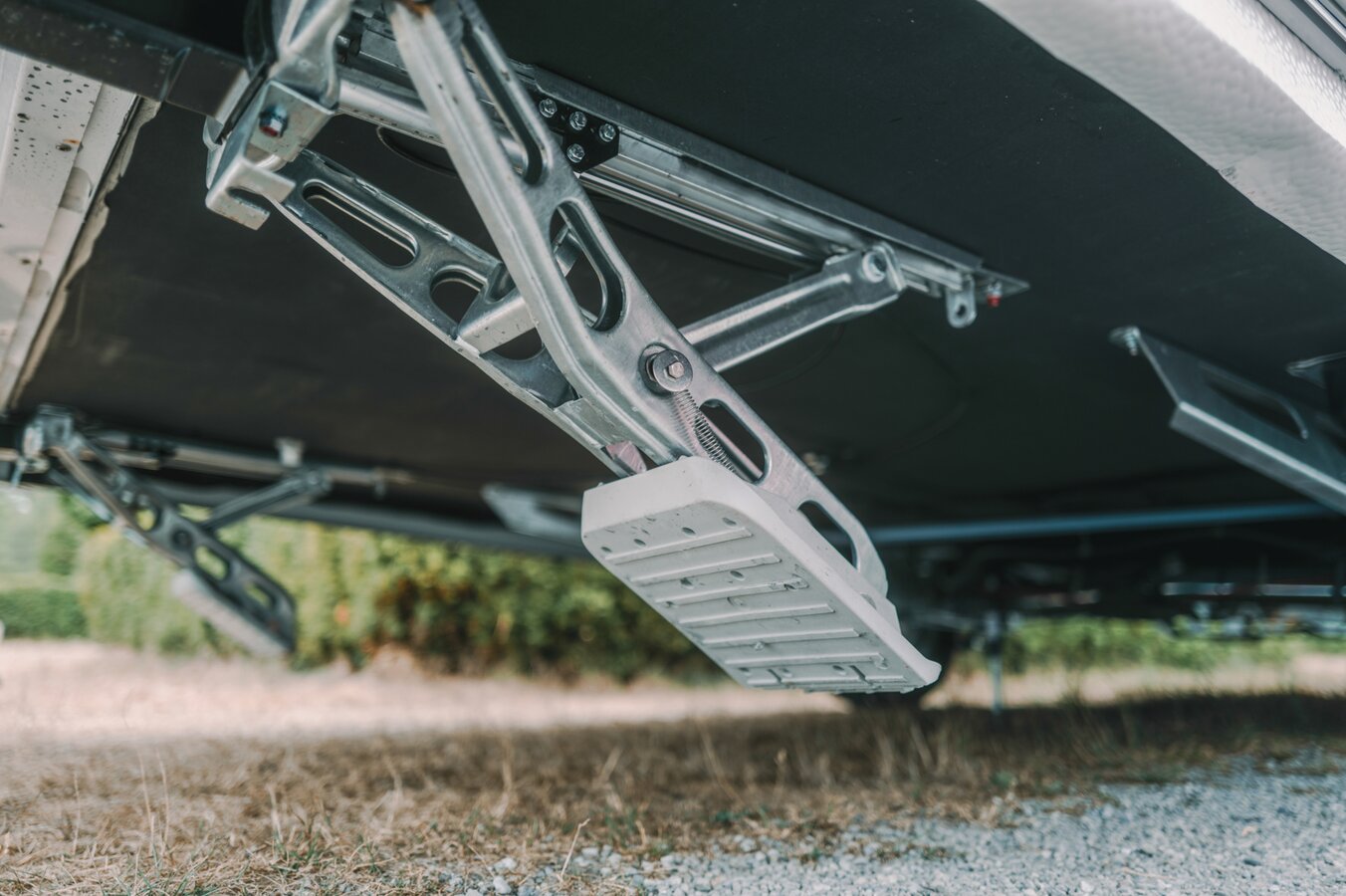
For special ground conditions such as soft or uneven surfaces, AL-KO Big Foot feet are helpful. This support accessory has an extra-wide footprint (20 x 18 cm), increasing stability. Fitted directly to the supports, these 'flat feet' provide additional security when parked, and prevent slipping on difficult surfaces.
They are also a far more elegant solution than using bits of board. When the supports are folded up, the Big Foot fits directly on the caravan's underbody.
Retrofitting mechanical AL-KO VT supports with Big Foot support feet is child's play. They can be fitted to any AL-KO VT Stabilform or Premium support from model year 2001 onwards. Older supports can also be retrofitted with the AL-KO VT Big Foot by simply drilling mounting holes as per instructions prior to installation.
- Suitable for: all Stabilform supports
- Price: €129
Why mechanical and electric caravan supports are not a substitute for a jack
Supports are called supports for a reason. Contrary to what many campers believe, they are not intended for aligning the caravan, but merely provide a stable stand. If a caravan is lifted using the supports, for example to level the vehicle or change a wheel, considerable forces are applied locally to the chassis. This can distort the chassis and damage the bodywork.
The only exception: With the LevelC hydraulic caravan support system from AL-KO VT, it is permitted to lift the caravan. Unlike other support systems, the rams of the LevelC main hydraulic supports are applied directly to the axle. This means that the main load is transferred into the frame near the axle via the large supports, which eliminates the risk of structural distortion.
Changing a wheel
Changing a wheel must always be done using the AL-KO VT jack, which is specifically designed for AL-KO VT chassis and operates in a way that prevents damage to the chassis. The AL-KO VT jack is available as a mechanical model for caravans up to 2,000 kg and as a hydraulic model for caravans up to 3,000 kg.
Jacking up over winter – necessary or pointless?
The topic of jacking up the caravan for winter is often discussed on camper forums. But is it really worthwhile?
Expert Oliver Drinkwater has a clear recommendation: “In fact, chassis are nowadays so robust that they can easily cope with long periods of standing. Nonetheless, the tyres or the suspension pack in the axle benefit from relieving the load during this time. You can relieve the load by placing axle stands at the frame near the axle. It’s the strongest section of the whole chassis. In addition, you can support the caravan with the steady legs. However, relieving the load via the steady legs is fully sufficient for winter storage.”
To avoid damage to the chassis, the caravan should only be relieved and not lifted entirely so the suspension is hanging. This means only slightly raising the axle. You can see this on the wheels. The axle is correctly relieved when the wheels are not suspended in the air but still just touch the ground. The ‘flat spot’ normally caused by the weight of the caravan on the tyres then disappears.