Stable in Every Situation with the Right Caravan Support Legs
For every camper, properly supporting the caravan is essential for a successful holiday. This can be done with simple manual plug-in supports, but it’s even more comfortable with electric and hydraulic support legs.
We’ll show you the differences between all AL-KO VT systems and answer the frequently asked question of whether support legs can also be used for propping up over the winter break, for example.

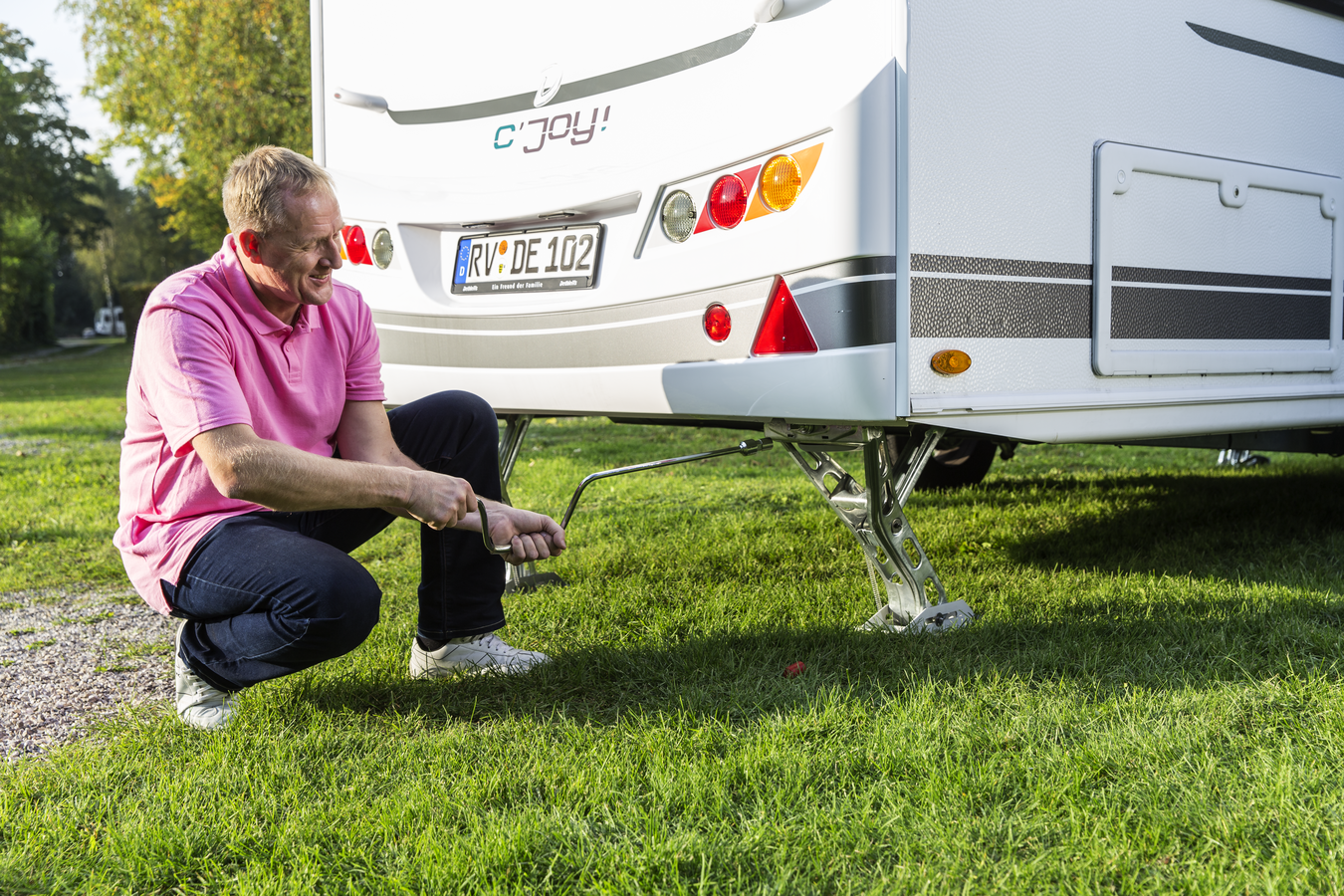
Mechanische Stützen
Der Klassiker unter den Wohnwagenstützen
Geeignet für alle Camper, die ihr Gefährt durch Kurbeln gerne selbst manuell abstützen wollen, bieten sie absolut sicheren Stand auf jedem Terrain. Sie lassen sich einfach montieren und sind in verschiedenen Varianten für jedes Chassis zu haben. Stellen Sie Ihren Caravan auf weichem Untergrund wie Sand, Schlamm oder Schnee ab, kann jedoch selbst die beste Stütze leicht einsinken. Hier ist es ratsam, für eine stabile Unterlage (z. B. Holzbrettchen, Steinplatten oder AL-KO Big Foot Stützenfüße) zu sorgen.
Tipp: Viele Camper nutzen einen Akkuschrauber für das Hoch- und Herunterkurbeln der Stützen. Das ist sicher bequemer, als die Stützen per Hand hochzukurbeln, gleichwohl müssen wir davon abraten. Insbesondere bei der Nutzung von leistungsstarken Werkzeugen besteht die Gefahr, den Wohnwagen anzuheben. Das kann nicht nur den Aufbau, sondern auch das Gewinde und die Schraubaufnahme beschädigen. Möchten Sie den Akkuschrauber nutzen, dann nur mit allerhöchster Vorsicht und achten Sie darauf, dass dies nicht mit voller Leistung geschieht.
AL-KO VT Plug-in Support Legs
The plug-in support legs from AL-KO VT are available in two versions: as Styleform support legs, they can bear up to 1,000 kg, while the premium support legs can handle up to 2,500 kg.
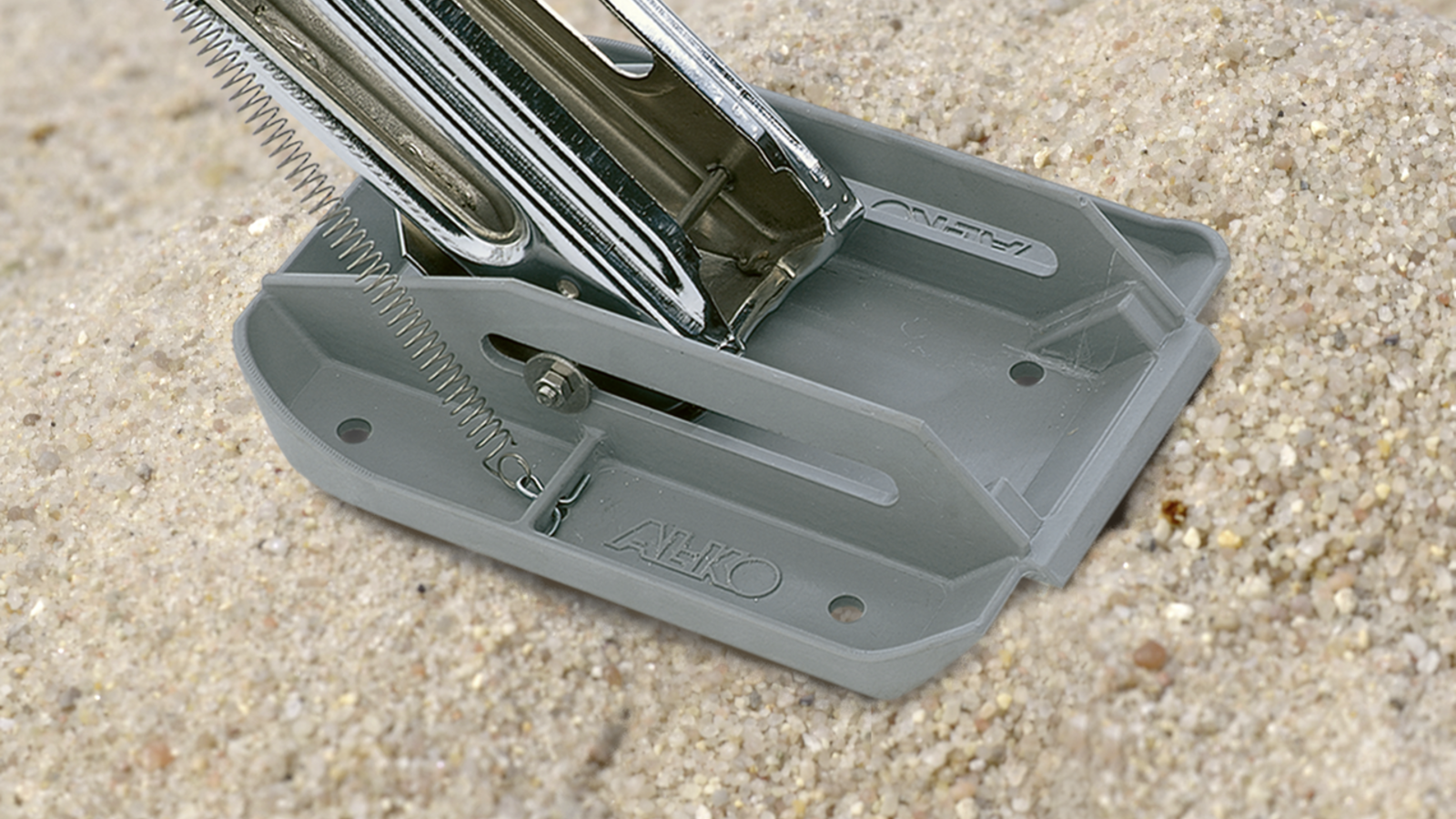
For special ground conditions such as soft or uneven surfaces, the AL-KO VT Big Foot feet are particularly useful. These accessories for the support legs are extra wide at 20 x 18 cm and thus provide a larger contact area. Mounted directly to the support legs, these ‘flat feet’ offer additional stability, greatly reducing the risk of slipping on poor ground.
They are also a much more elegant solution than placing boards underneath. When the support legs are folded up, the Big Foot can remain mounted on the underside of the caravan.
Retrofitting mechanical AL-KO VT support legs with Big Foot support feet is, incidentally, incredibly easy. They can be fitted to any AL-KO VT Styleform or Premium support leg from the 2001 model year and onwards. Even older support legs can be retrofitted with the AL-KO VT Big Foot. You will just need to drill mounting holes as per the instructions before attaching them.
Elektrisch betriebene Stützen
Für die Extraportion Bequemlichkeit beim Parken
Wer des Kurbelns müde geworden ist und keine Lust mehr auf Kniebeugen hat, findet in Stützensystemen mit Elektromotor eine bequeme Alternative. Elektrische Stützen sind das Richtige für alle, die ihren Rücken schonen und ihren Caravan möglichst entspannt abstellen wollen. Insbesondere Reisecamper, die ihren Stellplatz regelmäßig wechseln, werden sich über den zusätzlichen Komfort freuen.
Tipp: Auf kleinen Plätzen besitzen elektrische Stützen einen weiteren Vorteil. Der Wohnwagen kann möglichst nahe an Hecken oder andere Platzbegrenzungen gefahren werden, weil kein Platz zum manuellen Herunterkurbeln mehr nötig ist.
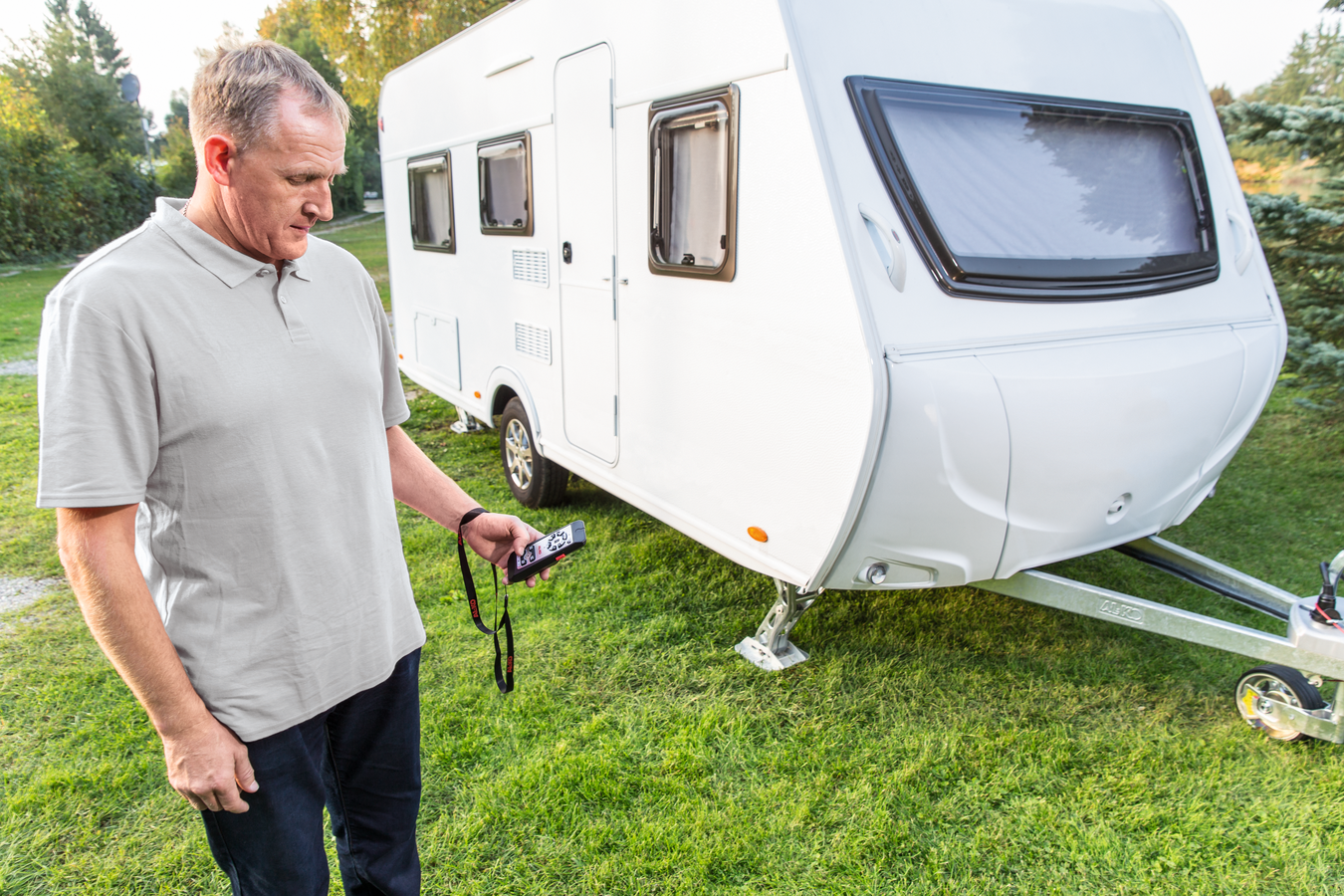
AL-KO VT UP4 Electric Support System
With the UP4 electric support system from AL-KO VT, setting up is both comfortable and much quicker than using a hand crank. Using a remote control, all four support legs can first be electrically extended and then individually adjusted to the correct height. This saves you time when setting up and allows you to safely park your caravan at the touch of a button, with no effort whatsoever.
UP4 is compatible with caravans of up to 2.5 tonnes, and thanks to its hot-dip galvanised metal parts, it is protected against corrosion—ensuring your support legs last for many years. In the premium version, AL-KO VT Big Foot support feet are fitted as standard, providing the necessary stability on soft or yielding surfaces.
Another advantage: The electric support system can easily be combined with the AL-KO VT Ranger manoeuvring system. Together, they make a true dream team. While the AL-KO VT Ranger safely manoeuvres your caravan into position—even on steep or narrow terrain—UP4 brings the support legs into the right place at the touch of a button. Both are conveniently operated via a single remote control.
An additional security feature: the UP4 support system offers built-in theft protection, so the support legs can only be moved manually using a special key. This prevents any unauthorised access.
The UP4 support legs are suitable for any AL-KO VT chassis and can also be installed retrospectively.
Hydraulic Caravan Support Legs
The Rolls-Royce of support systems
If you’re out and about with your caravan and finally find a nice spot for the night, you probably want just one thing: to pitch up and relax. However, the ground is often uneven, and it’s rare to find a pitch so flat that levelling your caravan is quick and easy. Usually, setting up takes up valuable holiday time—with a spirit level and carefully placed wheel chocks.
But there is a solution: With hydraulic levelling support legs, the stress of setting up and levelling your caravan is a thing of the past. Hydraulic support legs get your caravan perfectly level at the touch of a button—both lengthwise and crosswise—in just a few minutes so you can start your holiday straight away.
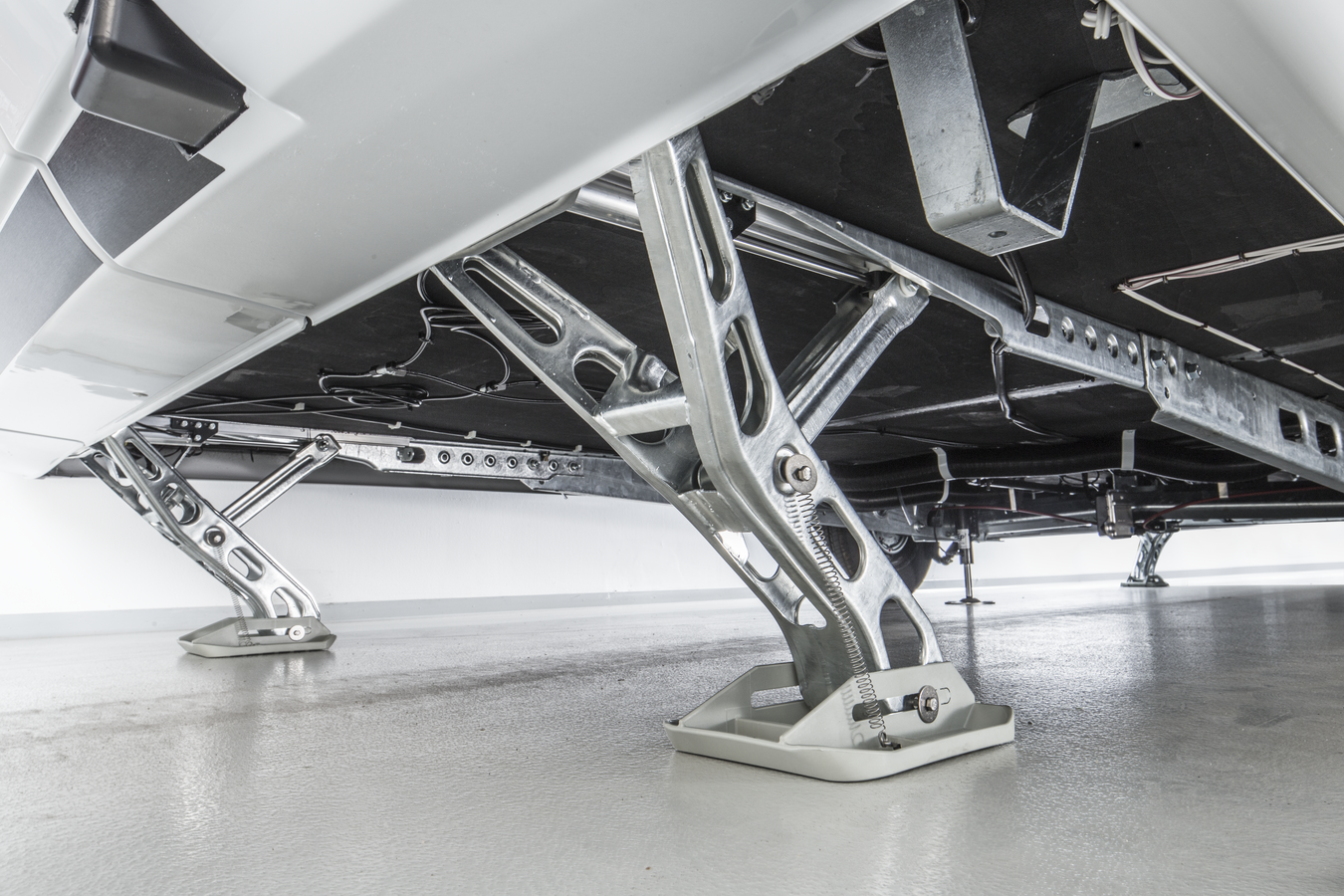
Hydraulic Levelling Support Legs LevelC
It takes just two minutes for the LevelC hydraulic levelling system to fully automatically bring a caravan into a level position.
A total of six hydraulic support legs do all the work. In the first step, two main support legs positioned left and right of the axle are extended, levelling the caravan laterally. In the second step, the longitudinal axis is aligned. Instead of mechanical corner steadies, the LevelC system uses hydraulic Big Foot corner steadies, taking the caravan to a perfectly level final position. This is aided by an electronic spirit level built into the control unit.
The system can be operated via:
- a fixed control panel,
- a small touchscreen, which sits in a fixed docking station in the caravan but can be removed at any time. Once removed, the tablet acts as a wireless remote control, allowing the whole system to be operated from outside the vehicle, too.
- a smartphone app, which uses the same user interface as the tablet.
You would be hard pressed to find a more automated or faster way to set up a caravan. By levelling first across the width and then the length of the caravan, and by moving two support legs at a time in parallel, the chassis is also protected against harmful twisting forces.
As described, LevelC is available as a complete system with six hydraulic support legs, but can also be ordered as a compact system with two hydraulic axle support legs and four mechanical corner steadies.
Real added value: LevelC is compatible with almost every type of caravan and may be dismantled and reinstalled in another caravan at any time.
Why Mechanical and Electric Caravan Support Legs Do Not Replace a Jack
Support legs are called ‘support legs’ because their function is to support a parked vehicle. Contrary to what many campers believe, support legs are not designed for levelling the caravan—they are only there to ensure stability. If a caravan is raised using the support legs, for example to level it or to change a wheel, significant forces are exerted at specific points on the chassis. This can distort the chassis and damage the body.
The only exception: With the LevelC hydraulic caravan support leg, the caravan may be lifted. Unlike other support systems, the two main hydraulic support legs of LevelC pick up the load at the main axle jacking points, meaning the main load is transferred via large support legs close to the axle and there is no risk of twisting.
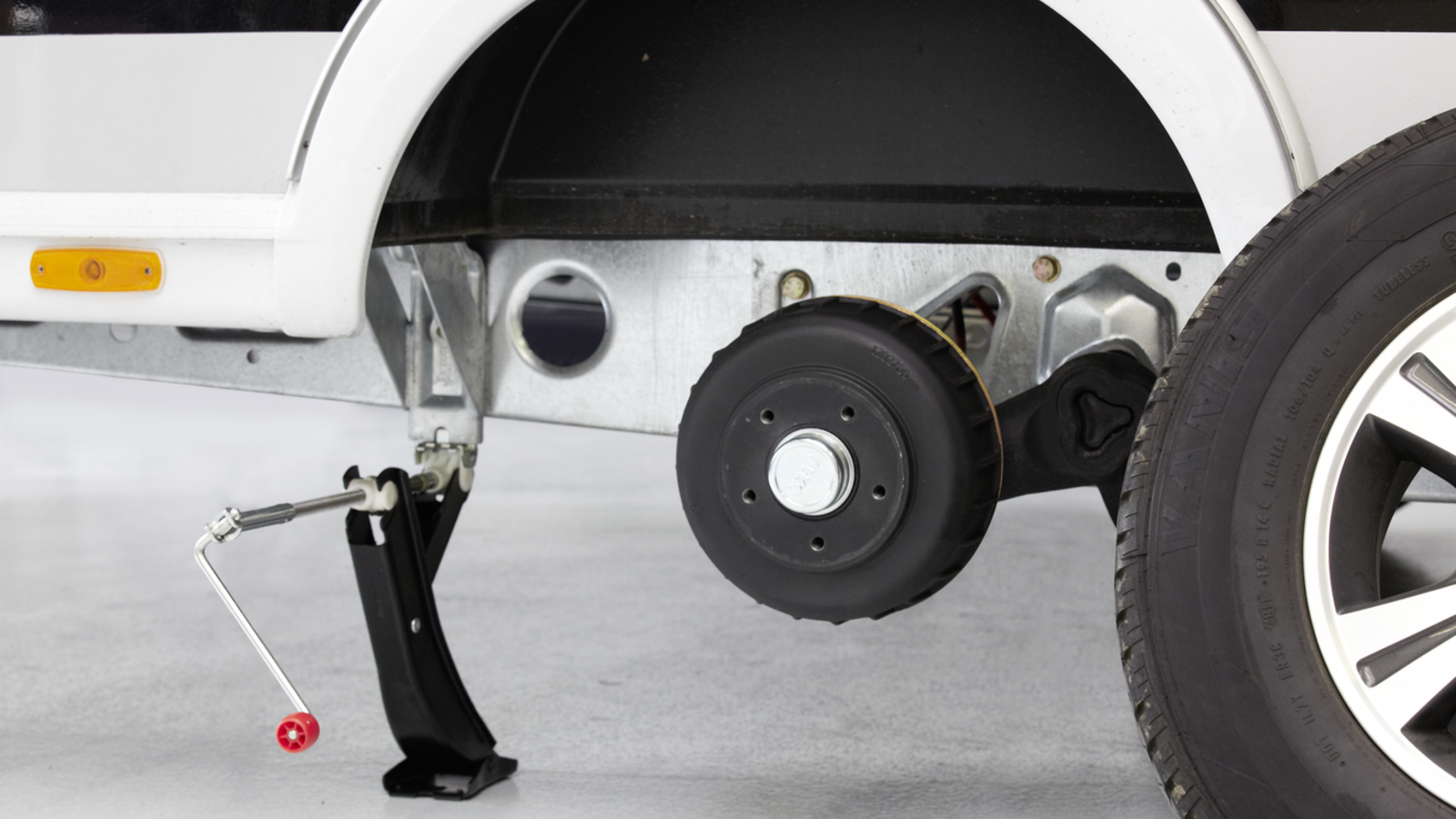
Changing a Wheel
Wheel changes should always be carried out using the AL-KO VT jack, designed specifically for AL-KO VT chassis and ensuring that no damage occurs to the chassis. The AL-KO VT jack is available both as a mechanical model for caravans of up to 2,000 kg and as a hydraulic model for caravans of up to 3,000 kg.
Propping Up Over Winter – Necessary or Not?
The topic of propping up during the winter is often debated in camper forums. In reality, modern chassis are so robustly built that they can cope well with long periods at a standstill. All the same, the tyres and the suspension in the axle benefit from having the load relieved during this time. This can be achieved using axle stands positioned close to the axle, which is the most stable part of the whole chassis. Additionally, the caravan can also be supported by its support legs.
However, relieving the load via the crank support legs is also completely sufficient for overwintering. To avoid damage to the chassis, only relieve the caravan – do not completely lift it out of its suspension. Relief means that the axle is only slightly raised. You can tell this by looking at the wheels: correctly relieved means that the wheels are not completely off the ground, but still have light contact with it.
Tip: The so-called ‘flat spot’ caused by the caravan’s own weight on the tyres will no longer be visible.
