Camping with a Dog – Relaxed Holidays for People and Pets
For many campers, a holiday without Rocky or Waldi is unthinkable – and for many pets, especially dogs, camping is the ideal holiday, offering lots of nature, freedom and family time. But: travel stress can be an issue! How can you best prepare for your camping trip with your dog? We've put together some helpful tips for you.

The essentials at a glance
- Travelling with your dog: Camping is one of the best options
- Packing, test drives, pitch selection – key factors for a successful trip
- Tips for a well-stocked travel medical kit for your dog
Tips for a successful holiday with a 'wow factor'
Camping is a wonderful way to enjoy a relaxed and eventful holiday with your four-legged companion. Whether it’s walks on the beach, sightseeing or swimming in the sea: make the most of the best time of year with your dog, away from stressful hotels and strict rules in holiday apartments! While cats, budgies and the like sometimes join in, statistics show that dogs are the number one camping companion.
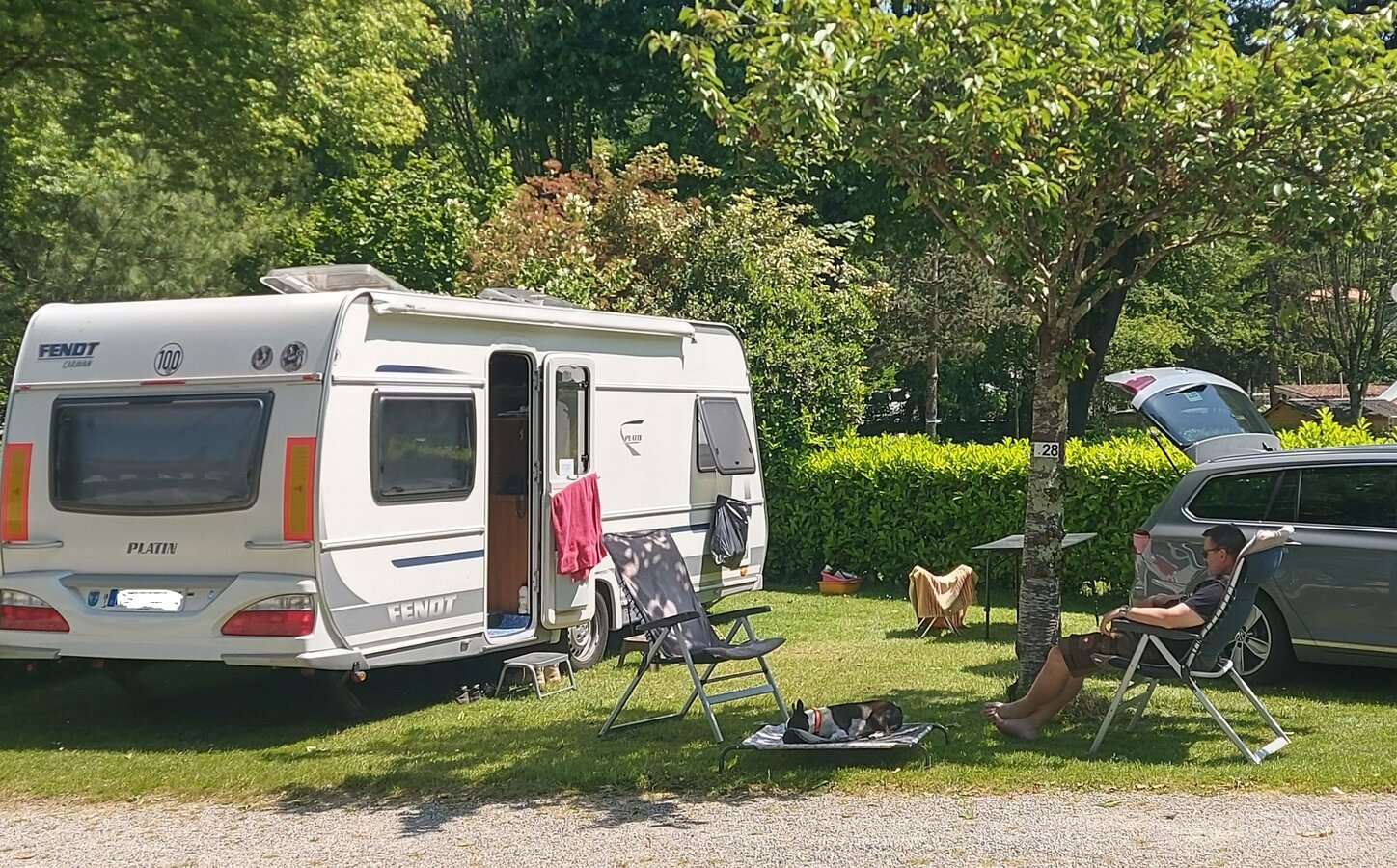
Take the Boston Terriers Sirius and Osito, for example: together with their owners Andrea and Dieter, they love travelling to the sea, as well as hiking and sightseeing. In this blog post, the family shares their experiences and tips for camping holidays with dogs.
What’s different about a holiday with a dog? “It’s the level of organisation! It starts with thoroughly researching the destination – are animals (in our case, dogs) allowed, is the campsite dog-friendly, and what activities are available nearby?” Dieter reports from years of holiday experience. After all, your trip will only be relaxing if both you and your furry friend feel at home.
Below you’ll find plenty of practical tips – from travel planning to helping your dog settle into the camper, to how people and pets behave on the campsite.
Finding suitable campsites
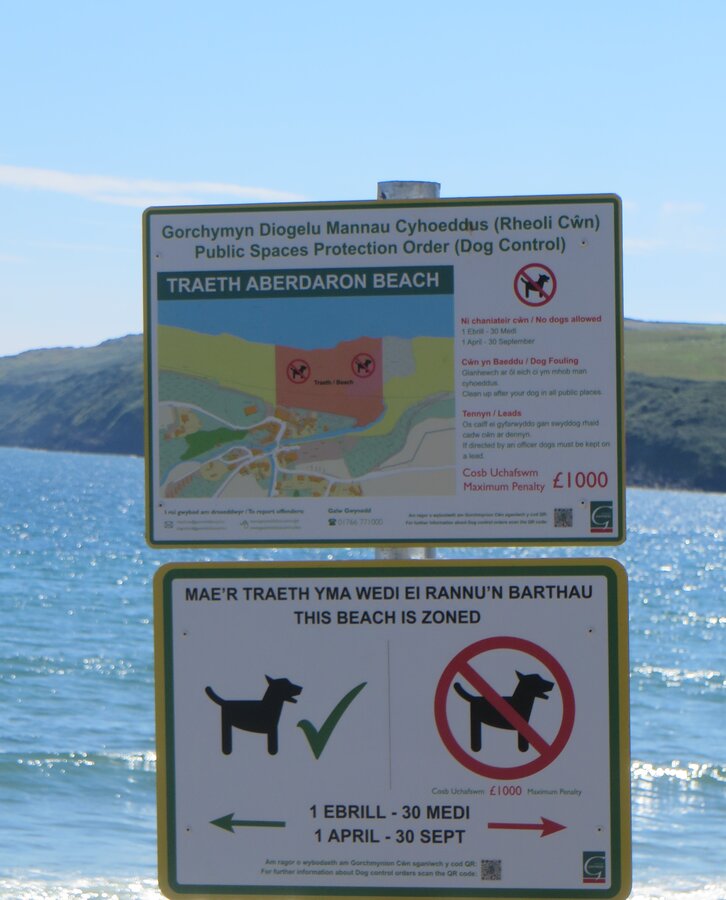
Dog-friendly campsites often feature dog showers, exercise areas, dog beaches and agility courses. On campsites where dogs are simply allowed, there may not be any special facilities for them.
Online you’ll find many websites for campsites with various facilities for dogs, for example at hundefreundliche-campingplaetze.de. Camping portals like Pincamp or camping.info also provide information and search options for sites that welcome dogs. The article 'Dog-friendly Campsites' on the CamperStyle online magazine highlights sites in various European countries.
Start preparations in good time
Preparation includes making sure in advance whether your dog needs entry documents, whether vaccinations are up to date and what health risks might be relevant in your destination country. It’s best to talk to your vet several weeks before your trip to see if any precautions or medication are necessary for your destination.
Important: For travel outside the EU – and for re-entry into the EU – you’ll often need special health documents which must be issued within certain time frames. The same applies to any parasite treatments required. Check the relevant authorities’ websites for details. For an overview of important documents and treatments when travelling within the EU, visit: https://europa.eu/youreurope/citizens/travel/carry/pets-and-other-animals/index_de.htm.
Packing properly for your pet
Food, toys, crates, blankets, buggy: When it comes to packing, you’ll quickly see that dogs need a lot of gear. If you’re less experienced with packing for your dog, or it’s your first time camping with a dog, then a detailed list for planning your trip, including a packing checklist, can be useful. Be sure to include: a travel medical kit for both humans and dogs!
Travel kit for your dog
Gabriela Schmid is an animal therapist in Augsburg, and an experienced dog traveller herself. She recommends the following basic items for your travel first aid kit – always consider your dog’s individual needs and what they tolerate!
- Bandages
- Tick remover
- Bentonite clay (for vomiting or diarrhoea)
- Deer tallow (for dry, cracked paws)
- Traumeel* ointment for dogs (for joint problems, sprains)
- Valerian tea (for agitation): Important: use a weak brew and let it cool down, give as an extra to water bowl!
- Onion juice (for insect bites): Apply away from eyes, nose, and inside ears!
- Olive oil (for ear mites): Best applied with a pipette into the ear.
- Aloe vera (for sunburn): A fresh leaf is best – apply the gel directly to the affected area. Otherwise, use an ointment. Collies and white cats are particularly at risk from sunburn.
- Saline solution (for conjunctivitis): Add a tablespoon of salt to a litre of lukewarm water, mix well, and gently rinse the eye. Avoid drafts or cold air (especially at sleeping area and while driving).
Test drives for familiarisation
If your dog is not an enthusiastic passenger, it’s best to introduce them to car journeys gradually. The sound levels in a motorhome are quite different to a quiet car, even just from starting the engine. Start your practice runs well ahead of your trip, so there’s enough time for training – with a dog trainer if required. Make sure your dog has a secure place in the car or motorhome – not just safe, but somewhere they feel comfortable, either with a seat belt or a fixed crate.
Equipping your motorhome and caravan appropriately
Space requirements and comfort are always important issues in campers. Depending on your destination and travel time, the size and number of dogs, and your individual needs, the following (extra) features are worth considering for your motorhome or caravan:
- Air conditioning
- Additional suspension system for increased ride comfort
- Hydraulic levelling system for safe and stable positioning of your panel van, motorhome, and caravan
- Anti-snake system for safe towing with the caravan
- Manoeuvring system for easy parking of the caravan
- Additional theft protection such as a PROSAFE wheel clamp
Dieter has also made his caravan more comfortable for travelling with Sirius and Osito: “Without our MAMMUT manoeuvring system from AL-KO, we would have been stuck several times – sometimes the pitches at the campsite were extremely tight, or the slopes were too steep to handle manually. Once, the driveway to the campsite was so narrow that we had to uncouple and manoeuvre with the MAMMUT around the corner! He also always has the PROSAFE wheel clamp with him: ‘PROSAFE gives us peace of mind, especially when our home on wheels is left all alone on a campsite, which does happen from time to time.’”
Safety while driving
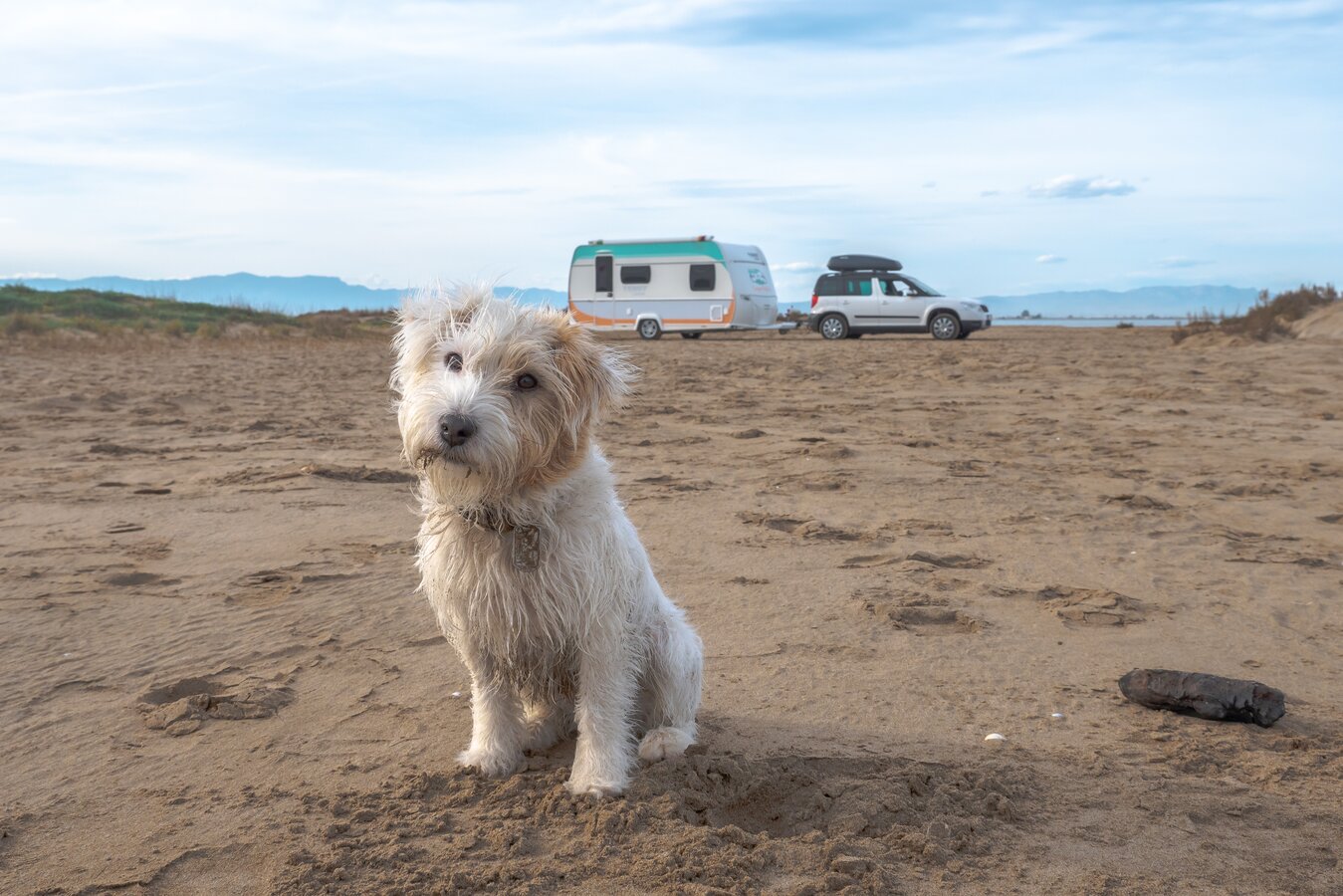
By law, a dog in the car is considered cargo. You are free to transport them anywhere you like in your car, van or motorhome. In general, you have these options:
- Transport crate in the car or rear garage
- Dog crate in the motorhome (note: can become a projectile – ensure it is securely fixed!)
- Secured with a harness and seat belt
And don’t forget: Plan enough breaks for yourself and your four-legged friend!
Holiday at last! Behaviour on the campsite
Once you arrive, choosing the right pitch is crucial for a relaxed and restful holiday for both people and pets. Ideally, you should opt for a plot where your dog can choose between a cool, shady spot or basking in the sun. If the pitch is on the edge of the site with more peace and less foot traffic, that’s an added bonus.
For a secure and stable base, make sure your camper or caravan is level using a suitable system, for example, a hydraulic levelling system for your motorhome. A correctly levelled and secure vehicle not only improves sleep quality but also ensures calm and restful breaks for you and your four-legged friend.
In most European destinations, dogs must be kept on a lead or tethered at your pitch – out of consideration for other campers. It’s important to check the site rules to find out what’s allowed and what’s not. Recommended tying solutions are tie-out posts that screw into the ground, or mobile ground anchors, or a suitable tree – the main thing is that it’s a sturdy object. For hard ground, you can use plates with rings that fit under the wheels of your camper. If off-lead exercise is allowed, many campers use a dog fence to let their pet roam freely on the pitch, but not at the neighbour’s coffee table.
Even if your furry friend doesn’t care for movie nights, they’ll appreciate a cosy spot in the evening or an air-conditioned motorhome on a hot day: Our electronics portfolio includes everything from control panels to solar regulators – for smart, connected tech controlled via app.
Once you’ve set up your little holiday home on four wheels, it’s time to enjoy family time with your dog. Want to make the most of your time together? Animal therapist Gabriela Schmid has put together mindfulness tips – for even more “wow” on your holiday!
In focus: Mindfulness and care for your four-legged friend
Give your four-legged companion an extra dose of attention every day. Note any changes and, if necessary, take pictures – your records may be helpful for the animal therapist or vet when making a diagnosis.
- Coat: Carefully inspect your dog’s coat: Are there bald patches? Is the coat dull? Are there areas where more hair than usual falls out when combing? For dull coats, you can add two or three drops of olive oil to their meals – it will help to restore shine.
- Paws: Before letting your dog out of the camper once you arrive, especially on hot days, check the ground temperature first with your hand. A dog’s paws are sensitive and the ground will feel much hotter to them than it does to us. If your dog has dry, cracked paws, treat the pads with a deer tallow roll-on in the evening. This will make them supple again in just a few days.
- Claws: Normally, claws wear down naturally from walking. Check regularly that they are wearing down evenly. Uneven wear when placing the paw down can point to problems with the musculoskeletal system.
- Ears: Gently open your dog’s ears and examine them. Do you notice any irregularities, lumps or abscesses? Small black dots could indicate ear mite droppings, especially if your dog often shakes their head because of itching. Use a pipette to drop one or two drops of lukewarm olive oil into the ear. The olive oil will kill the mites within a few days. Important: never scratch crusts from the ear! Do not use cotton swabs or your finger in the ear canal!
- Teeth: Look at the lining of the mouth. Do you see irregularities or abscesses? Lumps? Redness? Most dogs develop tartar. You can carefully scrape tartar off with your fingernail. Cleaning with special dog toothpaste and a soft toothbrush can also work wonders. For bad breath, add fresh parsley to the food.
Diplom-Kauffrau Gabriela Schmid is an animal therapist in Augsburg. Contact: fellnasana@e-mail.de

After registering, you’ll receive exclusive information about products, innovations, offers and more directly to your email inbox.